
If you’ve ever stood in a furniture aisle comparing a bamboo shelf to an oak one, you’ve probably wondered the same thing everyone does: is bamboo actually better than wood, or just cheaper-looking? As we promised in our sustainability deep-dive, today we’re settling it with a full bamboo vs. wood comparison — durability, price, and environmental impact — including a few honest points where wood genuinely wins.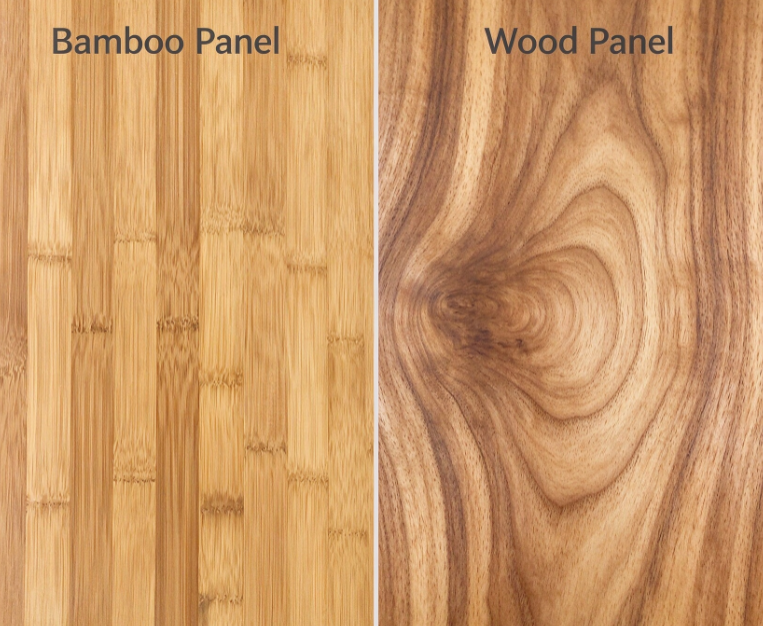
Round 1: Renewability — 5 Years vs. 40
Let’s start where wood can’t compete. Moso bamboo — the species used for virtually all bamboo home products — reaches harvestable maturity in 3-5 years. Oak, maple, and acacia take 20-60 years. And when bamboo is harvested, the root system stays intact and regrows on its own, like mowing a lawn rather than clear-cutting a forest.
From the same hectare, managed bamboo also produces far more usable material per year than timber. This is why bamboo has become the go-to sustainable wood alternative as demand for natural materials keeps climbing — the supply simply renews faster than any tree can offer.
Round 2: Durability — Stronger Than It Looks
Here’s where common sense misleads people. Bamboo looks light and hollow, yet strand-woven bamboo can be harder on the Janka hardness scale than oak or maple — commonly testing well above 2,000 lbf versus roughly 1,300 for red oak. That density is why bamboo cutting boards resist deep knife grooves, and why a bamboo shoe rack doesn’t sag the way cheap pine does.
Two honest caveats, though:
- Weight: bamboo is typically 15-20% lighter than a comparable hardwood piece. For a laundry hamper or wall-mounted coat rack you’ll move around, that’s a plus. For a massive dining table you want anchored, some people prefer hardwood heft.
- Knives: extremely hard bamboo can be slightly tougher on fine knife edges than softer woods like acacia — a fair point serious cooks raise, and we covered the full hygiene angle in our bamboo vs. plastic kitchen comparison.
Round 3: Water Resistance & Daily Care
Bamboo’s tight grain makes it naturally less absorbent than many softwoods, so it handles bathroom and kitchen humidity well — one reason bamboo bathroom accessories have become the default choice for plastic-free homes. Neither material survives the dishwasher, but bamboo generally forgives a forgotten wet towel better than pine or beech.
For maintenance, both want the same thing: keep dry between uses, oil occasionally, and they’ll easily last 5-10 years. A well-made bamboo organizer treated with reasonable care is a decade-long purchase, not a seasonal one.
Round 4: Price — The Cost-Per-Year Math
Upfront, bamboo usually sits 20-40% below comparable hardwood. A hardwood acacia board costs more than bamboo at the same size partly because the raw material took 30+ years to grow.
| Feature | Bamboo | Hardwood (oak/acacia) | Plastic |
|---|---|---|---|
| Upfront price | $ | $$–$$$ | $ |
| Typical lifespan | 5-10 years | 10+ years | 1-2 years |
| Maintenance | Occasional oiling | Occasional oiling | Replace when cracked |
| Cost per year | Low | Low–medium | Surprisingly high |
A $30 bamboo shelf lasting 8 years beats a $60 hardwood shelf used for 12 only if you’d actually keep it that long — but both crush plastic on cost-per-year. The real trap is “cheap” fast-furniture that gets replaced every two years.
Round 5: Eco-Impact — The Nuanced One
This is the round where we stay honest, because the answer isn’t a slogan.
Bamboo’s wins: 3-5 year renewal, no replanting, minimal water and pesticides, and high carbon absorption per hectare in managed groves. As we detailed in our 8-facts sustainability article, it’s one of the lowest-impact raw materials available at scale.
Where wood fights back: a solid, certified hardwood piece can last generations and be repaired rather than replaced — longevity is its own form of sustainability. And most bamboo products are laminated with adhesive, which complicates end-of-life biodegradability compared to untreated solid wood.
The Bottom Line
Bamboo vs. wood isn’t a fight with one winner — it’s a match-up where bamboo dominates on renewability, price, and humidity performance, while hardwood keeps the crown for lifetime furniture. For shelves, organizers, bath sets, and kitchen storage — the things you actually replace every few years — bamboo is the smarter, lighter, greener buy.
Frequently Asked Questions
Is bamboo stronger than wood?
Strand-woven bamboo often tests harder than oak on the Janka scale (2,000+ vs ~1,300 lbf), though it’s lighter. For everyday furniture and organizers, it’s more than strong enough — and more resistant to humidity.
Is bamboo cheaper than hardwood?
Typically yes, 20-40% less upfront, because bamboo matures in 3-5 years versus decades for trees. Over years of use, both beat plastic on cost per year.
Is bamboo more sustainable than wood?
For regularly replaced products, generally yes — bamboo regrows from its own roots in 3-5 years with no replanting. Certified hardwood can still be the greener choice for lifetime pieces thanks to repairability and longevity.
Does bamboo furniture last as long as wood?
With basic care, well-made bamboo products commonly last 5-10 years or more. Solid hardwood can last longer in heirloom applications, but for daily-use items the difference is small.
Ready to feel the difference yourself?
Explore our bamboo bathroom collections, kitchen organizers and living room shelves — grown in Fujian, crafted by a factory with 14 years of bamboo expertise.
Retailers and brands: Our OEM/ODM bamboo production delivers certified material from facilities in China and Thailand.
Post time: Oct-28-2026